Modern American Canasta: How to Play, Meld, and Score
This page covers everything you need to play a hand tonight. But Modern Canasta has a lot of nuance underneath — the timing of a pack pickup, when to sit on a Special Hand, how to read your partner’s discards, and more. That’s the difference between knowing the rules and actually mastering the game.
Two ways to close that gap:
- For the ultimate learning experience, connect with a CLA-Certified Instructor. CLA’s partner Canasta University has a network of Canasta Teachers across America, who teach the game hands-on, in person or online.
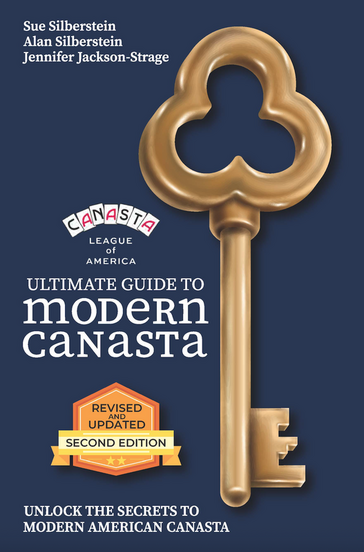
- We also recommend the official CLA Ultimate Guide, a comprehensive textbook written by three veteran canasta instructors that covers basic and advanced strategies for playing Modern Canasta.
Keep this page bookmarked as your quick reference.
Setting up and the deal
Choose one player at the table to keep score. The Scorekeeper cuts the deck and passes the bottom portion to the player on their left, who deals 13 cards to each player.
The Scorekeeper then takes the bottom 8 cards of their hand and sets them to one side of the tray. The ninth card is placed sideways. This is the Turn Card, and the rest of the deck goes on top of it to form the draw pile. Whatever cards remain after the deal are added on top, and play begins with the player to the dealer’s left, moving clockwise.
Cards, wilds, and threes
Every card falls into one of three groups, and knowing them is the foundation of everything that follows:
- Wild cards: 2s and Jokers. They stand in for other cards inside a meld.
- Special cards: 3s. These are handled apart from normal play (more below).
- Natural cards: every other rank, 4 through Ace.
When a 3 turns up in your dealt hand or is drawn during your turn, place it on the table straight away and draw a replacement card, unless you are working toward a Special Hand. Threes are never discarded, and their value at the end of the hand depends on your canastas, which we cover in the scoring section.
Melds and canastas
A meld is a set of three or more cards of the same rank, kept in your partnership’s meld area. Once a meld reaches seven cards, it becomes a canasta, the heart of the game.
- A natural (clean) meld contains only natural cards.
- A mixed (unnatural) meld includes at least one wild card. It must always keep at least two natural cards and may never hold more than two wilds.
- Once a meld has five natural cards, you may add a wild card to it.
- When a canasta of a given rank is complete, neither team may start or add to that rank again. Those cards become Dead Cards.
Special melds
- 7s may never contain a wild card; they are always natural.
- Natural Aces must stay pure, unless the wild card was added during your initial meld. A mixed Aces meld is treated as an ordinary mixed meld, not a special one.
- Wild card melds are allowed, but once you start one, your team cannot add wild cards to any other meld until that wild canasta is complete.
- A team may not go out while holding an incomplete natural meld of Aces, 7s, or wild cards on the table.
How a turn works
The game moves clockwise, and every turn has the same shape: draw, meld (if you can), and discard.
1. Draw or pick the pack
Begin by either drawing one card from the draw pile, or picking up the entire discard pile (the “pack”). To pick the pack, you must first take its top card and immediately use it, either to start a new meld with at least two matching natural cards from your hand, or to add it to an existing meld. Once that meld is down, the rest of the pack goes into your hand.
You cannot pick the pack if your team already has a meld of five or more cards in that rank, since that would push the meld past seven.
2. Meld
On your turn you may lay down new melds or add to your own. You may never play onto an opponent’s meld. Keep at least one card in hand after melding. The exception is when you are going out, or when you have just picked the pack and are entitled to play the whole hand.
3. Discard
End every turn by discarding one card face-up. A few restrictions apply:
- 3s are never discarded.
- Wild cards are only discarded as a last resort: when it is your final card for going out, or when you truly have nothing else. You may not manoeuvre yourself into that position on purpose.
- SWAD: Sevens, Wilds, Aces, and Dead cards cannot be discarded onto an empty tray (as the first player, or right after picking the pack). If SWAD cards are all you hold, you must take back your melded cards, most recent first, until you have a legal discard, even if that means breaking a canasta or returning the pack.
The initial meld
Each team’s first meld of the hand must meet a minimum point count, and that minimum rises as your score grows. The Scorekeeper announces each team’s requirement before the hand begins.
| Your team’s current score | Minimum point count required |
|---|---|
| 0 to 2,995 points | 125 points |
| 3,000 to 4,995 points | 155 points |
| 5,000 points or more | 180 points |
An initial meld must include a Clean Triple: three or more natural cards of the same rank, with no wilds, and not of a rank that is already Dead. You may reach the point count by adding one or more mixed melds alongside it. Unnatural canastas are never allowed as an initial meld.
If you use the top discard as part of your opening, the meld must be valid before you collect the rest of the pack, and that discarded card cannot count toward your minimum or be part of your Clean Triple.
Special Hands
A Special Hand is a rare, high-value opening. If, after drawing, you hold one of the hands below and your team has not yet made its initial meld, you may lay down your entire hand with no discard. This is your team’s only meld for the round, and it ends the round at once. Every Special Hand contains 14 cards, and none may include a 3 (with the sole exception of the Straight).
| Special Hand | Composition | Value |
|---|---|---|
| Pairs (no wilds) | Seven different pairs, no wild cards. Example: 66 77 88 99 JJ QQ KK | 2,500 |
| Wild Pairs | Seven pairs including Aces, 7s, and one matching wild pair (2s or Jokers). Example: 66 99 JJ QQ 77 AA 22 | 2,000 |
| Miami Pairs | Seven pairs including Aces, 7s, and both wild pairs (JoJo and 22). Example: 66 99 QQ 77 AA 22 JoJo | 2,500 |
| Zip Code | Two pairs + two sets of three + one set of four (2-2-3-3-4). Matching wilds allowed. Example: 88 JoJo QQQ KKK 4444 | 2,500 |
| Straight | One card of every rank, including a 3 and both wilds (A 2 3 4 5 6 7 8 9 10 J Q K Jo). | 3,000 |
| Garbage | Two sets of four + two sets of three, no wilds (4-4-3-3). Example: 8888 QQQQ 555 KKK | 3,000 |
| Blast Off | One five + one four + one three + one pair (5-4-3-2), matching wilds allowed. Example: KKKKK QQQQ 888 22 | 3,000 |
| Triples | Four sets of three + a matching wild pair (3-3-3-3 + 2). Example: 888 QQQ KKK 444 JoJo | 3,500 |
| Quads | Three sets of four + a matching wild pair (4-4-4 + 2). Example: 8888 QQQQ KKKK 22 | 3,500 |
| Dream Hand Plus 4 | Two sets of five + four matching wilds (5-5 + 4). Example: 44444 KKKKK JoJoJoJo | 8,500 |
| Dream Hand Plus 5 | One five + one four + five wilds (5-4 + 5). Example: 44444 KKKK 222JoJo | 8,500 |
The two Dream Hands are worth 8,500 points and win the game outright. When a team declares a Special Hand, the opposing team still scores its own hand in the normal way.
Going out
You may go out (end the play) only when both conditions are met:
- Your team has completed at least two canastas.
- You can meld all but one of your cards, discarding that last card (any card except a 3).
The play also ends when there are no cards left to draw. If the very last card drawn is a 3, the hand stops immediately: the 3 stays in hand and counts as a 5-point penalty, with no replacement possible.
Scoring the hand
At the end of each hand, every team scores based on how many canastas it completed, its 3s, and the face value of its melded cards. The table below shows, at a glance, when each item helps or hurts.
| Scoring item | No canastas | One canasta | Two or more | Special Hand |
|---|---|---|---|---|
| Canasta & going-out bonuses | – | Added | Added | – |
| Incomplete-canasta penalties | Deducted | – | Deducted | – |
| Threes | Deducted | – | Added | – |
| Wilds, 7s and Aces | Deducted | Added | Added | – |
| Cards left in hand | Deducted | Deducted | Deducted | – |
| Special Hand score | – | – | – | Added |
Canasta values
| Canasta type | Points |
|---|---|
| Mixed (unnatural) canasta, any rank except 7s | 300 |
| Natural canasta, any rank except 7s or Aces | 500 |
| Natural Aces or 7s canasta | 2,500 |
| Wild canasta with one to three Jokers | 2,000 |
| Joker canasta (all four Jokers + three 2s) | 2,500 |
| Wild canasta of all 2s | 3,000 |
A team that goes out earns an extra 100-point bonus.
Scoring the threes
Threes swing with your canastas. With no canasta they are a penalty; with one canasta they are neutral; with two or more they become a bonus. The point value depends on how many 3s of the same colour you have melded:
| 3s of the same colour | No canastas (minus) | One canasta | Two or more (plus) |
|---|---|---|---|
| One | −100 | 0 | +100 |
| Two | −300 | 0 | +300 |
| Three | −500 | 0 | +500 |
| Four | −1,000 | 0 | +1,000 |
Value of melded cards
If your team has completed at least one canasta, add the face value of every melded card (other than 3s) to your score.
| Card | Point value |
|---|---|
| Jokers | 50 |
| Aces and 2s | 20 |
| K, Q, J, 10, 9, 8 | 10 |
| 7, 6, 5, 4 | 5 |
If your team completed no canastas, the value of your melded cards is subtracted instead, along with everything left in your hands.
Penalties
- Incomplete natural Aces meld: −2,500
- Incomplete 7s meld: −2,500
- Incomplete wild card meld: −2,000
- Three or more Aces left in hand: −1,500 (plus their face value)
- Three or more 7s left in hand: −1,500 (plus their face value)
- Cards remaining in hand: their full face value is subtracted from your score.
Special Hand scores
| Hand | Points |
|---|---|
| Pairs (no wilds) | 2,500 |
| Wild Pairs (with wilds, Aces & 7s) | 2,000 |
| Miami Pairs | 2,500 |
| Zip Code | 2,500 |
| Straight | 3,000 |
| Garbage | 3,000 |
| Blast Off | 3,000 |
| Triples | 3,500 |
| Quads | 3,500 |
| Dream Hand Plus 4 / Plus 5 | 8,500 |
Winning the game
The goal is to reach 8,500 points or more. As soon as one or both teams cross that line, the game is over and the higher score wins. It is a game you grow into: every hand teaches you a little more about when to open, when to hold, and when to close.
These are the official rules used across the Canasta League of America and on its recognized online platform, Canasta Junction, the CLA’s official place to play Modern Canasta online, whether you are practising a Special Hand or joining a friendly game.
Play Like You’ve Been at This for Years
Learn faster with a CLA Certified Instructor, in person or online.
Find a Teacher For online practice and play, visit:Canasta Junction